Alopecia - male and female pattern
LAST UPDATED: Mar 16, 2025
Introduction
This chapter discusses male pattern alopecia (androgenetic alopecia) and female pattern alopecia, and is set out as follows:
Aetiology
Male pattern (androgenetic) alopecia
- Is an androgen-dependent trait. The terminal hair follicle becomes susceptible against dihydrotestosterone, which leads to shortening of anagen phase and miniaturisation of terminal to vellus hair. The development of male androgenetic alopecia is predominantly hereditary. In men, family analyses show strong concordance rates in twins and increased risk for sons with bald fathers. Moreover, variant regions on the androgen receptor gene and at chromosome are associated with the development of androgenetic alopecia in men. It is very uncommon for women to loose hair following the male pattern unless there is excessive production of androgens
Female pattern (androgenetic) alopecia
- In most cases the cause is idiopathic or familial. A smaller group have associated hyperandrogenism, eg secondary to the Polycystic Ovarian syndrome
Clinical findings
Clinical - male pattern
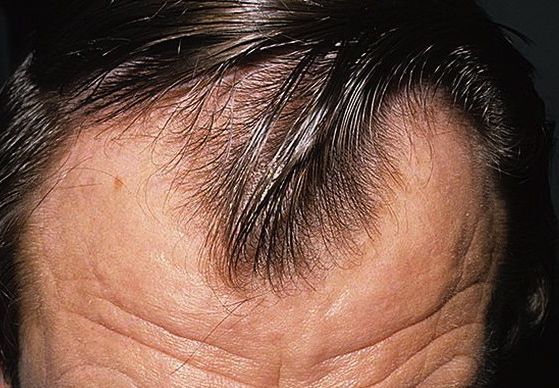
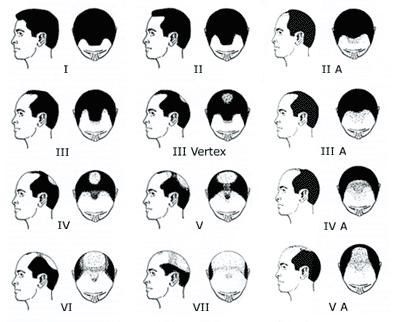
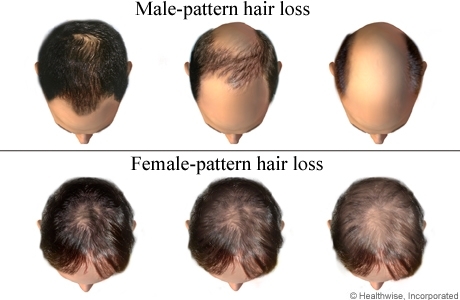
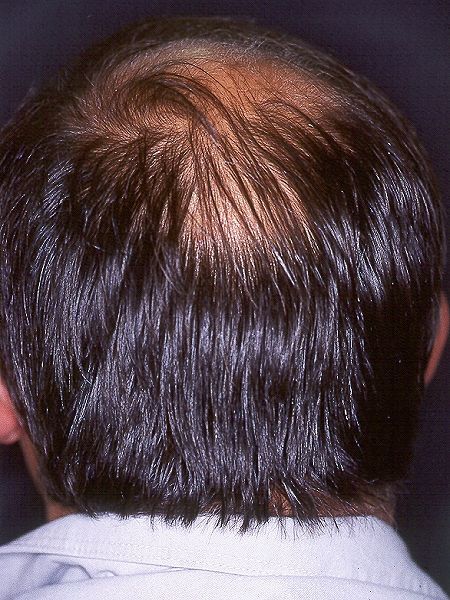
- Recession of the frontal hair line, mainly in a triangular pattern is the characteristic finding, later followed by thinning of the vertex
- Predominantly affects men, but occasionally women with hyperandrogenism
Clinical - female pattern
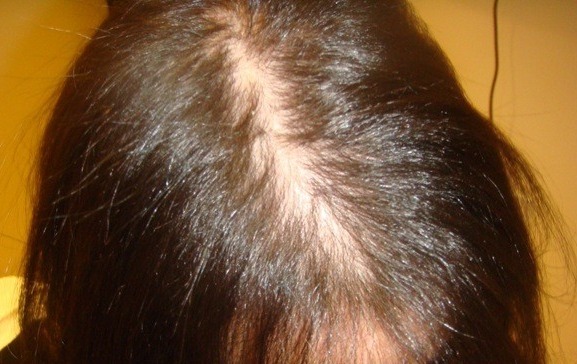
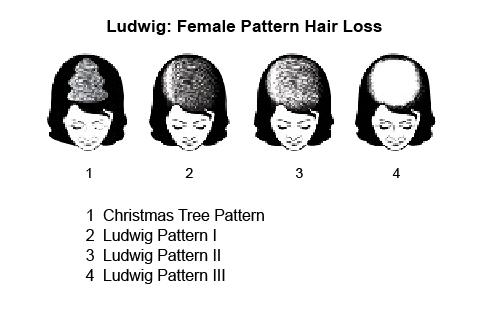
- Ludwig pattern - is characterised by a diffuse thinning of the centroparietal region with maintaining of the frontal hair line. It is the most common type in women, occasionally also observed in men
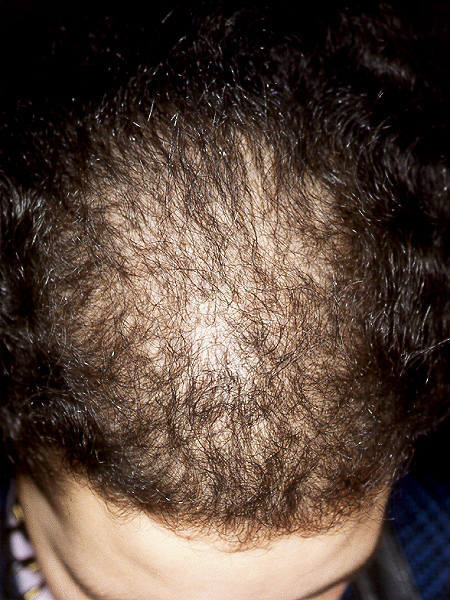
- Christmas tree pattern - this is similar to the Ludwig pattern in that the Christmas tree pattern shows diffuse centro-parietal thinning, but additionally, the frontal hair line is breached
Dermoscopic features
- In a normal scalp each follicle with have several hairs
- In male and female pattern alopecia some of the follicles are either empty or have a solitary hair. The hair is of differing diameter with more than 20% in affected areas being small and fine ie miniaturised. Some of the empty hair follicles are filled with yellow sebum
Clinical Images
Please refer to notes on image rights at bottom of the page with regards to individual image
ownership.
Investigations
-
In women, if there is associated evidence of clinical hyperandrogenism eg acne, hirsutism and irregular periods, further investigations are needed - refer to the related chapter Hyperandrogenism
Management
Advice
- Provide patient information leaflets
No treatment
- Patients need to be well-informed of the possible benefits vs risks of the various treatments before making a decision. Some may opt for no treatment
- Hair products containing nanofibres can help stick hair together to give an appearance of thicker hair
Minoxidil
Topical minoxidil
- Topical minoxidil does not alter the natural history of hair loss; rather it can thicken / increase the density of remaining hair as a result of slowing down hair shedding. It is estimated to benefit 40% of patients
- It is best used at an early stage. It is not affective for more established alopecia when patients are no longer reporting increased hair shedding
- The 5% formula is recommended BD for men and OD for women, although some women use BD
- Minoxidil comes as a solution or foam - if using the foam the correct amount is a large tangerine-sized blob
- Skin irritation can arise, but usually settles
- Optimal results are seen between 6-12 months. If beneficial, treatment needs to be continued otherwise the scalp will return to its original state
Oral minoxidil
- Has been shown in small studies to lead to significant regrowth of terminal hairs in some patients
- A common starting dose is 0.25 mg per day, increasing to 1mg per day if tolerated
- Contraindications include pregnancy, severe hepatic impairment, and cardiac disease
- At 14% of cases, hypertrichosis is the commonest adverse effects; others include tachycardia, dizziness, and fluid retention
- Optimal results are seen between 6-12 months. If beneficial, treatment needs to be continued otherwise the scalp will return to its original state
5-alpha reductase inhibitors in men
- Are a relatively commonly used treatment
- Dutasteride 0.5 mg per day appears the most effective with an increase in the total hair count and improvements in serial photographs. An alternative is Finasteride 1 mg per day , although a single dose of 5 mg per week is probably as effective and cheaper. Higher doses of finasteride confer no additional benefit
- Up to 90% of patients may benefit from treatment, which needs to be continued to maintain efficacy
- Before prescribing such drugs patients need to be aware of the following:
- There is a small risk of altered libido, erectile dysfunction, and ejaculation disorders, which can persist once treatment is stopped
- A reduction in PSA levels - the actual PSA level may be twice as high as what is reported
Anti-androgens and 5-alpha reductase inhibitors in women
Other non-surgical treatments
- Infrared light - studies have shown no statistical improvement
- Platelet rich plasma - although safe, more evidence is needed
Wigs
- Can be considered for patients with moderate to severe alopecia
- Patients can be referred (normally to local dermatology departments) for the provision of wigs, which are of sufficient quality to normally make for a good cosmetic appearance
- As well as wigs, other accessories and hair styling are also important considerations
Surgery - follicular unit transplantation (FUT)
- Can be performed in both male and female patients, although the outcomes appear better for men
- Patients need to have sufficient donor hair - the best site is from the neck region of the scalp
- Outcomes are variable, and depend to a large extent on the skill / experience of the surgeon
- Treatments are very expensive and patients need to give considerable thought before having such a procedure performed
Other resources
Disclaimer - the author PCDS cannot accept responsibility for any misleading or incorrect statements, and the management of individual patients remains the direct responsibility of the individual doctor. We do however hope that visitors to this site can contact us regarding comments that are considered misleading or incorrect so that we can continue to improve the site.
Image Rights - The PCDS would like to thank Dermatoweb, DermQuest (Galderma), and others who have contributed images. All named individuals and organisations maintain copyright for the relevant images.