Prurigo
LAST UPDATED: May 28, 2022
Introduction
Prurigo is a term used to denote a group of skin disorders characterised by intensely pruritic, and difficult to treat, papules or nodules. The best known of these conditions is nodular prurigo (syn. Hyde's prurigo), which typically presents with itchy nodules affecting the extremities, and consists histologically of hyperkeratosis and acanthosis, with downward projections of the epidermis. A similar condition, perhaps best-termed papular prurigo (syn. papular dermatitis; chronic prurigo of adults) consists of smaller lesions, and presents mainly in middle-aged women.
This chapter is set out as follows:
Aetiology
-
The cause is generally unknown
-
Emotional stress has a role in some cases
-
65-80% of patients are atopic
-
20% of cases report the condition starting after an insect bite
-
Lesions of nodular prurigo sometimes develop within eczematous areas of skin, which is then termed nodular pruriginous eczema
History
-
Nodular prurigo can arise at any age, but predominantly between 20-60 years
-
Both sexes are equally affected, although the papular form is more common in women
-
Itch is often very intense, and can gone on for hours on end, leading to vigorous scratching
Clinical findings
Nodular prurigo
-
Distribution
-
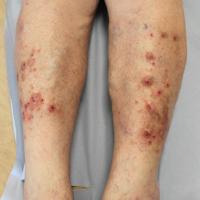
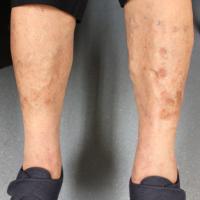
Lesions usually arise symmetrically on the distal limbs, and are worse on the extensor surfaces
-
Lesions may become widespread and very numerous
-
Morphology
- 1-3 cm firm nodules, often with a warty surface
-
Crust and scale may cover recently scratched lesions
-
Older lesions may be darker or paler than surrounding skin
-
The skin in between the nodules is often dry
- Chronology
- New nodules appear from time to time, but existing nodules may regress spontaneously to leave scars
- Nodular prurigo often runs a long course and can lead to significant stress and depression
Papular prurigo
-
Clinical findings are similar to nodular prurigo although lesions are smaller and most commonly affect the cape area
Clinical Images
Please refer to notes on image rights at bottom of the page with regards to individual image
ownership.
Investigations
- It is good practice to undertake a pruritus screen - refer to the related chapter Pruritus
- In atypical cases a skin biopsy may be required to confirm the diagnosis
Management
Step 1: general management principles
- Discuss expectations - prurigo is difficult to treat, often requiring a combination of treatments
- Reduce excoriations by cutting the nails very short, and wearing gloves at night
-
Start treatment early - the conditions becomes more difficult to treat as the size and number of lesions increase
-
Emollients - applied liberally and frequently to cool and soothe itchy skin. Menthol in aqueous cream is particularly cooling (various strengths)
-
Sedative anti-histamines such as hydroxyzine (Atarax®) 10-50 mg nocte. Additionally, some patients may require / tolerate smaller doses eg 10 mg tds through the day. Use periodically otherwise tolerance may develop, and there is a small amount of evidence potentially linking long-term sedating anthistamines with an increased dementia risk
Step 2: topical / intralesional corticosteroids
Topical and intralesional corticosteroids have all been used, although response is variable
- Topical steroids - potent to super-potent steroid creams / ointments (eg Dermovate®)
- Occlusion
- If lesions are localised then apply topical steroids to the lesions and emollients to the normal surrounding skin, and then occlude
- Occlusion can be overnight using Clingfilm (more affective than tubular bandages), or for several days at a time using Viscopaste ® dressings or Zipzocs ®
- Treatment may be needed for 2-3 months initially, and then periodically if successful
- Other treatment options include:
- Steroid impregnated treatments - there are two types, both of which can be left on for up to 24 hours before reapplying:
- Haelan ® tape (fludroxycortide tape) - attached is a video demonstrating how to use the tape
- Betesil ® medicated plaster (betamethasone valerate 2.25mg) - attached is a video demonstrating how to use the plaster
- Intralesional injections of triamcinolone acetonide into thicker nodules, repeating every 2-3 weeks until the lesions flatten
Step 3: neuropathic treatments
-
Anecdotally, low-dose gabapentin (or pregabalin) and tricyclic anti-depressants such as amitriptyline, have been reported to benefit some cases. Start at a small dose and gradually increase if needed / tolerated. A minimum of a 6-8 week trial is required, and if helpful continue
Step 4: phototherapy
-
UV light treatment using narrow-band UV-B (TL-01) or UV-A plus psoralen (PUVA) may be beneficial for prurigo and other causes of pruritus
Step 5: systemic treatments for nodular prurigo
-
Ciclosporin and azathioprine have been found to be effective in some cases
-
The response to systemic corticosteroids is very unpredictable
-
Thalidomide has been shown to be highly effective but is severely teratogenic and can cause a painful, peripheral neuropathy
Other resources
Additional images
1
2
Disclaimer - the author PCDS cannot accept responsibility for any misleading or incorrect statements, and the management of individual patients remains the direct responsibility of the individual doctor. We do however hope that visitors to this site can contact us regarding comments that are considered misleading or incorrect so that we can continue to improve the site.
Image Rights - The PCDS would like to thank Dermatoweb, DermQuest (Galderma), and others who have contributed images. All named individuals and organisations maintain copyright for the relevant images.