Staphylococcal Scalded Skin syndrome (syn. Ritter disease; staphylococcal epidermal necrolysis)
LAST UPDATED: Sept 23, 2022
Introduction
Staphylococcal Scalded Skin syndrome (SSSS) is an uncommon, superficial blistering skin condition, characterised by widespread erythema and exfoliation, mainly occuring in children under five years of age, although older children and adults can be affected. SSSS is caused by the exfoliative toxins (epidermolytic toxins A and B) of some strains of Staphylococcus aureus.
This chapter is set out as follows:
Aetiology
-
SSSS starts from a localised staphylococcal infection that is a producer of the two causative exotoxins (epidermolytic toxins A and B)
-
SSSS can occur individually or as outbreaks, eg in nurseries. Outbreaks are usually due to asymptomatic carriers who spread the infection to susceptible individuals. About 15-40% of healthy humans are carriers of Staphylococcus aureus
History
-
SSSS generally affects children under five years of age, particularly neonates. It is very uncommon in older children and adults although immunocompromised individuals as well as patients with renal failure and other chronic disease, regardless of age, may also be at risk
Clinical findings
-
The initial event tends to be a localised Staphylococcus aureus infection of the skin or upper respiratory tract, although this may go unnoticed
-
Fever and irritability are common but patients do not appear overly unwell, and the skin is generally non-tender
-
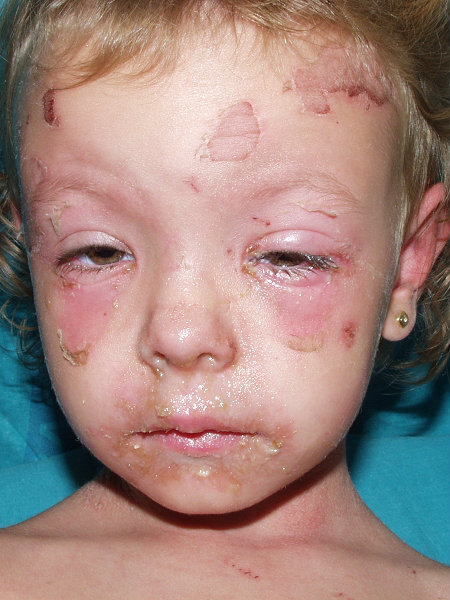
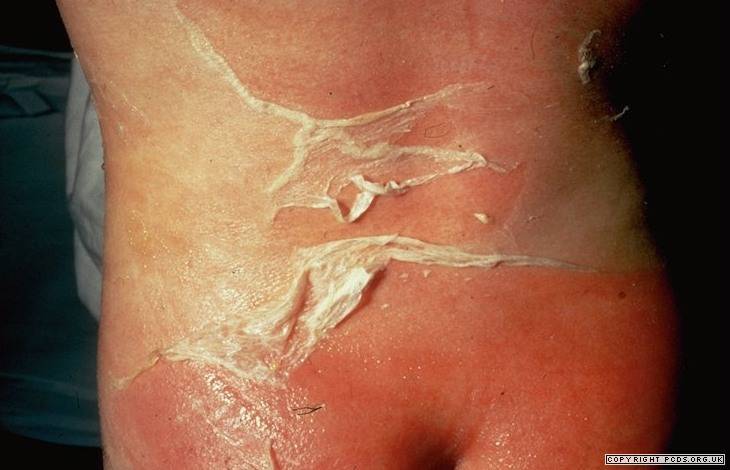
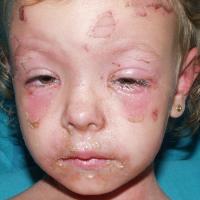
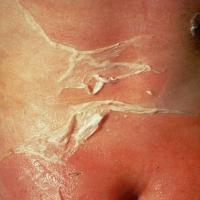
Macular erythema is followed by diffuse, confluent erythema with bullae, which rupture easily. There is marked epidermal exfoliation with the skin peeling off in sheets leaving exposed moist, bright-red, tender areas
-
The Nikolsky sign (gentle stroking of the skin causes the skin to separate at the epidermis) is positive
-
SSSS differs from the more severe, and generally drug-induced, toxic epidermal necrolysis (TEN), in that the cleavage site in SSSS is intraepidermal, as opposed to TEN, which involves necrosis of the entire epidermis
Clinical Images
Please refer to notes on image rights at bottom of the page with regards to individual image
ownership.
1
2
Investigations
-
Unless the primary infection site is observed swabs are often negative as the skin eruption is mediated by toxins
Management
-
SSSS requires prompt recognition and treatment. Same day contact should be made with the on-call dermatologist as hospital admission will almost certainly be required
-
Treatment includes:
-
Parenteral antibiotics to cover Staphylococcus aureus
-
Topical therapies, such as fusidic acid and/or mupirocin, are sometimes used as adjuncts to parenteral antibiotics
-
Supportive treatment
-
Children generally recover well and healing is usually complete within 5–7 days of starting treatment
-
The mortality rate from SSSS in children is very low (1-5%), unless associated sepsis or an underlying serious medical condition exists. The mortality rate in adults is higher (as high as 50-60%), although this may be a reflection of an underlying condition, which increased susceptibility to the infection in the first place
-
If there is an outbreak of SSSS in either a neonatal care unit or childcare facility, the possibility of a staphylococcal carrier in the vicinity should be investigated. Identification of the healthcare worker, childcare worker, parent or visitor colonised or infected with Staphylococcus aureus is key to managing the problem. Once identified these individuals should be given appropriate eradication therapy
Disclaimer - the author PCDS cannot accept responsibility for any misleading or incorrect statements, and the management of individual patients remains the direct responsibility of the individual doctor. We do however hope that visitors to this site can contact us regarding comments that are considered misleading or incorrect so that we can continue to improve the site.
Image Rights - The PCDS would like to thank Dermatoweb, DermQuest (Galderma), and others who have contributed images. All named individuals and organisations maintain copyright for the relevant images.